

Somewhere beneath the pale, wind-scraped sands of central Argentina, a creature barely larger than a human fist shuffles through the dark. Its shell glows bubblegum pink. Silky white fur spills from its edges. It looks less like a mammal and more like something sketched into a medieval bestiary by an artist who had never actually seen one.
The pink fairy armadillo, Chlamyphorus truncatus, is the world’s smallest armadillo species, measuring roughly 3.5 to 4.5 inches long. Sightings are so rare that scientists have never successfully kept one alive in captivity for long. Most of what researchers know comes from brief field encounters and a handful of preserved specimens.
That gap in knowledge matters. Without understanding how it lives, how it breeds, or how large its populations actually are, conservation efforts have almost nowhere to start. This article explores what the pink fairy armadillo is, how it survives Argentina’s harsh desert conditions, and why its elusiveness makes protecting it so difficult.
What Makes the Pink Fairy Armadillo So Unusual
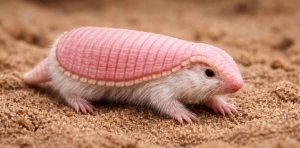
Barely longer than a human hand, this creature looks like something sketched in a medieval bestiary. Chlamyphorus truncatus, the pink fairy armadillo, holds the title of the world’s smallest armadillo species, typically measuring just 3.5 to 4.5 inches and weighing around 3.5 ounces.
The shell is the first thing anyone notices. Flexible and flushed a vivid bubblegum pink, the carapace sits loosely attached along the spine rather than fused to the body the way most armadillo shells are. Blood vessels running close to the surface give it that almost neon color, and scientists think this helps regulate body temperature in the scorching Argentine desert.
How It Lives Beneath Argentina’s Dry Grasslands
Tucked into the arid scrublands and sandy plains of central Argentina – primarily the provinces of Mendoza, San Luis, and Buenos Aires – the pink fairy armadillo has built its entire life around staying hidden. It favors loose, sandy soils where digging comes easily, and dry grassland or scrub vegetation where ants and insect larvae are reliably found just below the surface.
Almost everything happens underground. The species is nocturnal and solitary, emerging rarely and briefly, usually under cover of darkness. When threatened above ground, it can vanish into the soil with startling speed, using its flat rear shell like a plug to seal the tunnel entrance behind it.
Its diet includes ants, worms, insect larvae, and occasionally plant matter. Avoiding midday heat is non-negotiable in these semi-arid environments.
Sightings in the wild are genuinely rare. Researchers struggle to study the species at all, and there’s no denying that large parts of its behavior remain poorly understood.
Why a Creature This Elusive Is Still at Risk
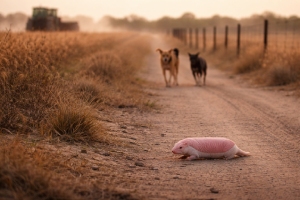
Scarcity offers no protection. Argentina’s central pampas and sandy scrublands are being steadily converted to soybean and cattle farming, which compacts the loose soil these armadillos depend on for burrowing. Domestic dogs and cats kill individuals that surface at night. Roads cut through their range, and small bodies moving slowly across asphalt rarely survive the encounter.
Scientists currently classify the species as data deficient under some assessments and vulnerable under others. Either way, the uncertainty is the problem. When researchers can’t count a population, they can’t measure decline until it may be too late. Protecting habitat now, before the numbers are confirmed, is the only practical path forward.
Some of Argentina’s Rarest Wildlife Lives Unseen
Of all the animals, this little critter, the pale pink pink fairy armadillo, lives most of its life underground in sand, impossible to observe, while conducting activities that scientists did not document until now. Most adapted to life in Argentina’s scrubby outback, the dig into sand with its peculiar claws. It has a set of specialized attributes: – incl. heat-regulating, flexible shell, and propensity to negotiate not very solid sage-kham areas. It considers both as merits and defects. Farming, predators, and soil disturbance could run over the local population with undue celerity. So much rarity, though, seems slightly mystical; natural invisibility invites deleterious consequences.